
You've hit your depot's power ceiling. We can raise it.
A 1.5 MW service supports four 350 kW chargers. UpGrid lets the same service run twenty — same bill, 5× the throughput.
Your service caps your fleet plan.
The utility service that powers four chargers today won't power twenty tomorrow. Expanding it means years of interconnect queue, transformer lead time, and switchgear rebuild — plus demand charges that scale with peak draw, not energy delivered.
At 350 kW each — the utility limit on direct grid power.
Peak-pricing penalty on a four-charger depot at $20/kW·mo.
Utility timeline to add the megawatts your fleet plan needs.
The battery does the heavy lifting. The grid stays flat.
UpGrid doesn't ask the utility for more power — it buffers what you already have. The battery charges while chargers are idle and dispatches when drivers plug in. Meter stays smooth; your operations see fast charging on demand. No fixed service at all? See Mobile EV Charging.
Top off
Off-peak pricing. Most chargers idle. UpGrid pulls slow and steady.
Peak charging
Battery and grid run in tandem. UpGrid OS dispatches based on session forecasts.
Demand-charge guard
Utility's peak window. Battery covers spikes so the meter never crests.
Recharge
Lowest tariff window. Full battery refill while the depot sleeps.
One AC tie-in. One battery. Twenty fast chargers.
UpGrid sits between your utility service and your DC fast chargers. AC comes in from the meter, gets converted once, lives on the DC bus until a driver plugs in. No second meter, no extra utility approval. See the full cabinet spec on UpGrid BESS.
meter
Running in the field.
Depots picked UpGrid when they needed more charging throughput than their utility service could deliver.

Porsche
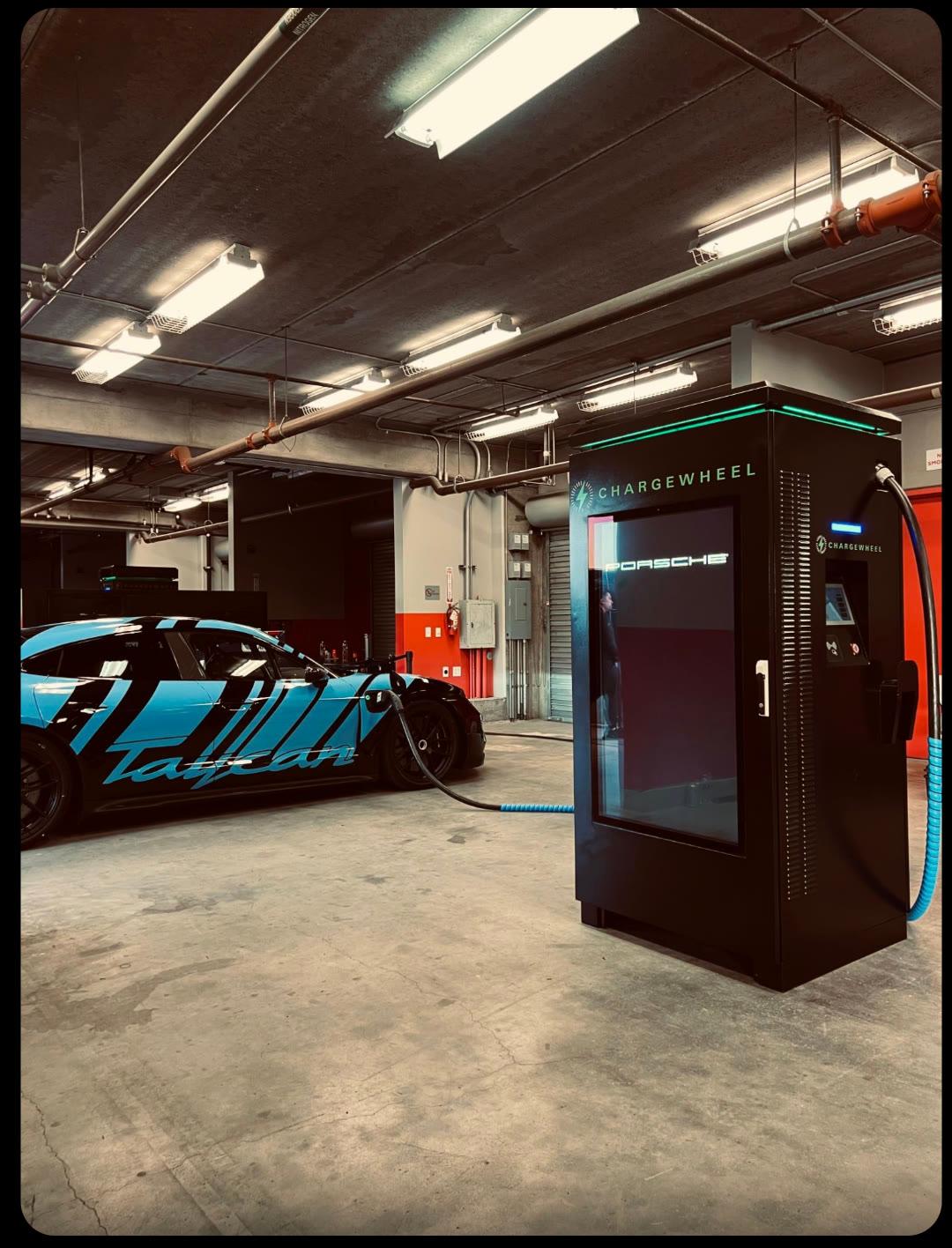
Battery-buffered DC fast charging at a Porsche customer-facing deployment — charging brand-new Taycans on the same utility service that used to cap session count.
A full ETL-certified charger lineup.
Mix and match across charger sizes to fit dwell time. Light-duty fleets run on 60 kW dispensers; long-haul corridors run on 350 kW. All models share the same payment, OCPP, and remote-management stack — see the full family on EV Chargers.
- Output power
- 60 kW
- Connector
- CCS1 / NACS
- Voltage range
- 200–1000 V DC
- Use case
- Vans, light trucks
- Certification
- UL 2202
- Output power
- 150 kW
- Connector
- CCS1 / NACS
- Voltage range
- 200–1000 V DC
- Use case
- Buses, mid-fleet
- Certification
- UL 2202 + CSA
- Output power
- 350 kW
- Connector
- CCS1 / NACS / CHAdeMO
- Voltage range
- 200–1000 V DC
- Use case
- Class-8 trucks, transit
- Certification
- UL 2202 + CSA + ETL
Full lineup spans CW 60 through CW 350M. All models OCPP 2.0.1 native, payment terminals optional, ISO 15118 plug-and-charge ready.
Model your depot.
Adjust the inputs to match your site. The numbers update live. Defaults start from a typical 1.5 MW transit depot.
Existing utility service at the depot
Share of time chargers actively dispense at rated power
Utility peak demand charge
Effective grid power multiplier with UpGrid
Send us your depot profile.
Share your tariff, fleet schedule, and dwell-time pattern. You'll get a system size, deployment timeline, and 5-year ROI within a week.
Questions fleet operators ask.
If we missed yours, it's probably answered in a 30-minute call with our engineering team.