
One charger family. 10 kW to 400 kW.
Modular DC fast chargers for fleet depots, highway corridors, and mobile units. OCPP 2.0.1 native, CCS1 + NACS, plug-and-charge, tap-to-pay.
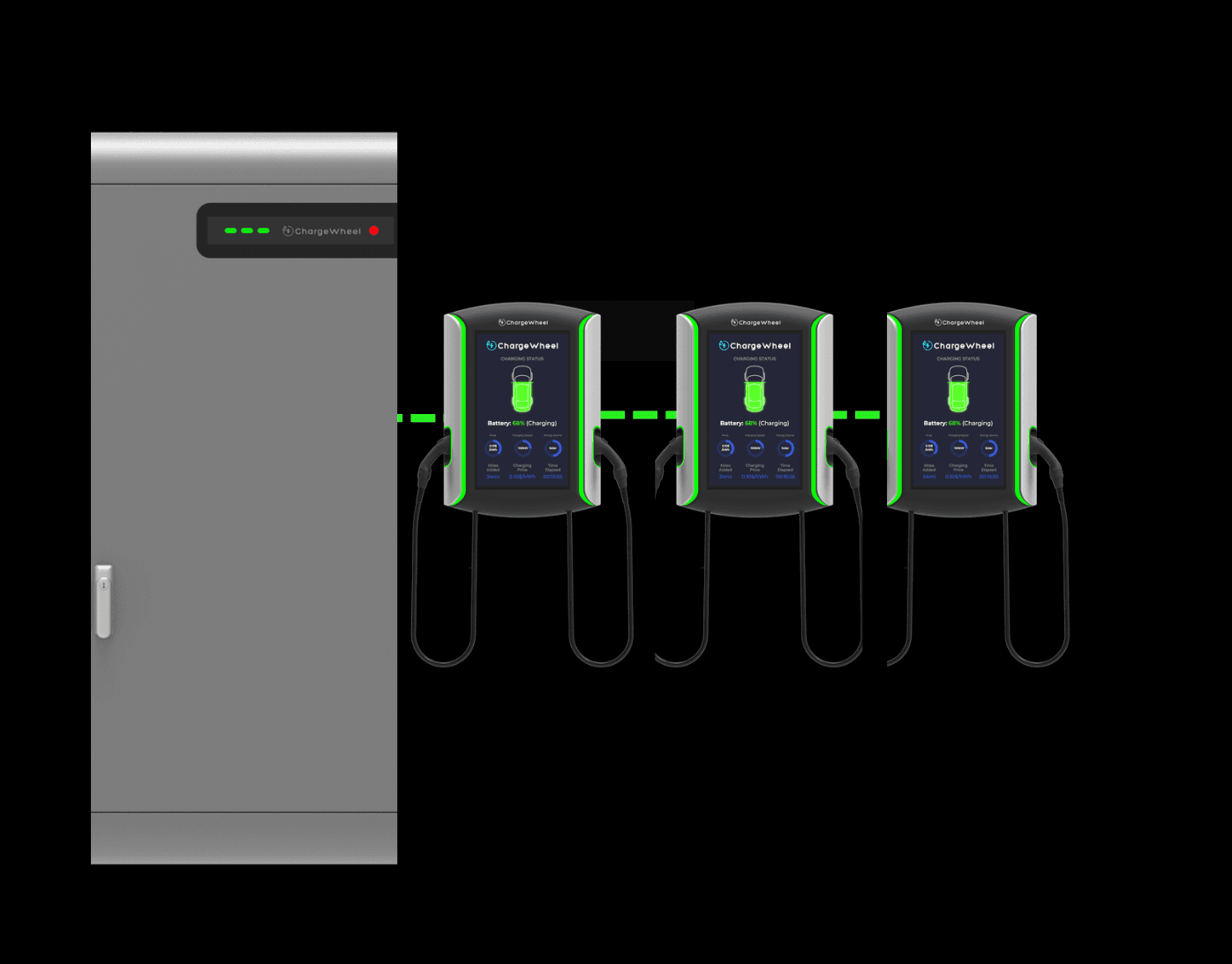
One board. Every deployment.
The same controller runs every tier — from a 10 kW workplace unit to a 400 kW corridor charger. Swap the power stage, the input stage, and the cabinet size; the software stack and back-office are identical.
Modular 10 – 400 kW
Same firmware, same OCPP endpoint — sized to each stall from light-duty to Class 8.
OCPP 2.0.1 native
Plug into any OCPP 2.0.1 back-office — UpGrid OS ships integrated, bring-your-own welcome.
DC or AC input
Same charger, your choice of source: AC tie from the grid or DC bus from UpGrid BESS.
Solar-ready
DC-input variants accept direct PV-string input — one fewer conversion between panel and car.
One board, six power classes.
Every charger in the CW family runs the same control board and firmware. Only the power-stage modules and cabinet size change — so you can mix CW 60s and CW 350s on the same site, under the same back-office, with the same diagnostic dashboard.
Pick your power source.
Every CW charger ships in two variants — same body, same dispensers, different input stage. DC-input pairs with UpGrid BESS or solar PV; AC-input drops onto any standard 480 V utility service. For portable or trailer-mounted deployments, see Mobile EV Charging.
Behind-the-meter & solar-ready.
Skips the rectifier stage — power flows battery-to-vehicle with one fewer conversion, higher end-to-end efficiency, and native solar integration.
Pairs natively with UpGrid BESS for 5 – 10× amplification behind any utility service.
Any 480 V service, anywhere.
Drop-in replacement for any DC fast charger already on AC. Same charger body and control stack — just a different input stage.
The quickest path when a grid tie already exists and BESS is not yet deployed.
Plug, pay, protocol — built in.
Every charger ships with the same payment, auth, and back-office integration — so mixing power tiers across a depot doesn't create operator complexity.
Both handles ship standard. CHAdeMO on CW 350+ by request.
ISO 15118 AC + DC. Auto-auth, auto-bill — driver just plugs in.
NFC terminal embedded. Apple Pay, Google Pay, and EMV chip.
Native — route to UpGrid OS or your existing CPO network.
Full spec sheet.
Electrical, environmental, connector, and network specs across the CW range. Detailed per-SKU datasheets available under NDA.
- SKUsModular
- CW 10 · 60 · 150 · 240 · 350 · 400
- Output power
- 10 – 400 kW · per stall
- Output voltage
- 200 – 1000 V DC
- Output current
- up to 500 A
- Efficiency (peak)
- ≥ 96%
- Power factor
- ≥ 0.99
- AC-input variant380 / 415 V also available
- 480 V · 3-phase
- DC-input variantFrom UpGrid BESS or PV string
- ≤ 1000 V DC
- Solar-ready
- DC-input · direct PV
- Isolation
- Galvanic · input ↔ output
- ConnectorsCHAdeMO on CW 350+ by request
- CCS1 + NACS
- Plug & Charge
- ISO 15118-2 · -20
- Payment terminal
- NFC · EMV chip · tap
- Cable management
- Retractable · 5 m standard
- Back-office
- OCPP 2.0.1 native
- Legacy OCPP
- 1.6J · firmware toggle
- UpGrid OS
- Pre-integrated
- Telemetry
- 4G LTE · Ethernet · Wi-Fi
- Cybersecurity
- UL 1740-1 · TLS 1.3
- Enclosure
- IP54 · NEMA 3R
- Operating range
- -30 °C to +55 °C
- Cooling
- Liquid · cables + modules
- Certification
- UL 2202 · CSA · ETL · FCC 15A
Full datasheet under NDA. Mix SKUs freely in a single deployment — same OCPP endpoint, same UpGrid OS dashboard.
Certified for US + Canada commercial deployment.
Every CW charger ships with the submittal packet your AHJ (Authority Having Jurisdiction — fire marshal and plan reviewer) already recognizes.
DC fast charger
UL 2202 listing for electric-vehicle DC fast-charging equipment.
Intertek listed
ETL intertek listing — commercial deployment across all 50 states.
Canada
CSA C22.2 for Canadian commercial and industrial installation.
Emissions
FCC Part 15 Class A for conducted and radiated emissions.
Spec out your charger deployment.
Share your depot plan, tariff, and vehicle mix. You'll get a charger count by SKU, single-line diagram, and deployment timeline within a week.
EV chargers — questions operators ask.
If we missed yours, a 30-minute call with our engineering team will answer it.